Showing posts with label FLEISCHMANN. Show all posts

Thursday, September 24, 2009

Fleischmann, Tomix, and Kato Roadbed Track


Most of my layout is Kato Unitrack, but through the purchase of various starter sets or unique track capabilities, I've got a little bit of track from Tomix (primarily for their tight radius Tram system), Fleischmann Profitrack (that came with a starter set, but also for some excellent flex track), Minitrix and Atlas.

I thought it might be interesting to provide a few photo comparisons of two of those track systems that have roadbed that are not real well known in the US; Tomix Finetrack and Fleischmann's Profitrack. For reference, I'll also add in a piece of Unitrack (There are two other track systems in N Scale that I am aware of...the new Atlas track system [forgot the name] and the Bachmann EZ Track system)!

The photo at top shows, from left to right, the Fleischmann Profitrack, the Tomix Fine Track, and the Unitrack. Below is a close up of the Fleischmann and Tomix tracks:

As you can see, the Fleischmann is the narrowest, at just about 16mm, Tomix is a bit wider at 18mm, while the Kato Unitrack appears to be a hefty 25mm in comparison!

While they are all Code 80 - and thank goodness for that! - its fairly obvious that they will need a little effort to get to work together. Tomix, interestingly enough, seems to put its rail joiners on the opposite side of other manufacturers, and with that 'cast in' connector on the Tomix roadbed, some sort of modification (or a Kato Unitrack joiner for this purpose) is necessary.

A final shot below shows a side view....nothing spectacular here, except they all obviously work off different geometries (so you'll have to do some tricks to get them to work together somehow). While I have definite plans to use Finetrack for a tram system in my downtown remodel (103mm radius curves and accessories to make it look like rails in the street...although Kato appears to be right behind them!), Tomix is also coming out with a single track super-elevated curve! That will be cool and will require some big changes to my layout - but super-elevated curves are worth it!

I also have additional plans for the Fleischmann track...given its relative elevation to Unitrack, this would be great track for yards...although the cost of switches with motors in their system is crazy (E.g.: when it makes the Kato #4 switch look like a real value...its too much!).


UPDATE 5 December 2009:

Mel in the comments section is building a layout for his Grandson, and had a question about whether or not an adapter is needed for the Fleischmann track with either Atlas (code 80) or Minitrix track.  Its a good question, and I expect other people will wonder as well!

Here's a couple of photo's of the three types: The first is the Minitrix track connected to the Fleischmann profitrack with just the standard rail joiners from each company:


 While its not perfect, I don't know if any sort of adapter would help.  Below is the Atlas code 80 track and Fleischmann:

The Atlas track as well works nicely with the Fleischmann track.  The Fleischmann track is hair taller, but this can easily be addressed by a very thin shim.   If it were me, I would not worry about an adapter.  I recall reading somewhere that Trix does make an adapter, but I think this was for another track system (Rapido?) that I don't use.

Good luck on your layout project! 

Thursday, August 20, 2009

Fleischmann / Roco Warranty Blues


I miss my Deutsche Bundesbahn Class 64!

I discussed some of my issues with my Fleischmann BR 64 locomotive in a post last winter. The BR 64 was performing very poorly and it was obvious something was really wrong. According to my dealer, the issue is that there is a gear issue and it is causing the wheel drive to get stuck and thus the poor performance. It seems that this is a clear design flaw that cannot be repaired and the locomotive needs to be replaced (good for him!) :-) He also informs me that my locomotive is one of four he has seen with the same problem (ouch! Bad for Fleischmann/Roco!).

It seems that when Roco acquired Fleischmann last year, all the Fleischmann managers were let go and there was also some signficant reorganization (both physical and organizational) which helps to explain the delay. That doesn't mean that I think this delay is acceptable, however. This is one of those occassions where a good dealer really pays off, they've already made their margins on this deal, and they do this all to support their customers. The benefit to the dealer (in this case) is that I definitely have high confidence in purchasing from them in the future! Thanks Walter!

For Fleischmann / Roco, however, another story. Given the relative premium they charge for their products (they seem to be the highest, even compared to Minitrix) I would like to expect a bit more from them right out of the box (especially as this locomotive came as part of a 'starter set'! What kind of impression does this leave with someone new to the hobby! Arg!!!) and despite a two year warranty, one certainly does not expect that a locomotive will spend a good portion of that time somewhere in a warehouse waiting to get 'looked at' rather than quickly replaced!

I hope this is not the future direction for the new Roco company and its Fleischmann acquisition, but we have seen similar sad developments in this hobby in the past. I would be interested to know if any others are also experiencing these sort of problems with Roco / Fleischmann?

Tuesday, April 14, 2009

Fleischmann and Trix Warranty Woes and Cheers

A quick post to share my (limited) experience with warranty service from the two main German N Scale manufacturers. I write this as I just shipped off my Kof II back to the dealer who will likely send it back to Germany for warranty service (unaccountable stops and stalls, which I think are more than just a symptom of the locomotives limited electrical contacts and dirty track issues). I am somewhat optimistic, as my one other experience with Trix was very positive.

And since these manufacturers do offer at least a one year (I see most are moving to two year) warranties, I intend to take advantage of it!

Trix / Marklin: "CHEERS!"
My Trix Mobile Station stopped working late last summer. Unable to resolve this through the manual, I took the somewhat intimidating step of collecting my reciept, composing a mail, and shipping the Mobile Station off to the Trix repair address in Germand.
Within a couple of weeks, I recieved an email notification that they had recieved my item and were working on it.
Less than 5 weeks after sending it, it was returned to me and has worked perfectly since then.
In my estimate, excellent service and responsiveness from Trix / Marklin.

Fleischmann: "Jeers"

I purchased a Fleischmann digital starter set last year, but had some problems with the Class 64 steam locomotive that came with it. Apparantly, it seems like it could be the drive rods are binding up, or something is wrong with the motor. I returned it to the dealer, and after an intial attempt to repair, I still experienced the same symptoms (jerky movement, stopping). The dealer then sent it back to Fleischmann in Germany for repair. Unfortunatly, this was back in late September, and as May is approaching, that means over 6 months with the manufacturer.
As my dealer explained to me, the Fleischmann/Roco merger is not going all that smoothly and a lot of things are delayed and not going entirely well. Be that as it may, 6 months for a warranty repair? Seems very excessive.

Again, neither of the above are representative examples given the small sample, but clearly my confidence in getting back a repaired Kof II from Trix (however, there's obviously the bankruptcy issue with Marklin / Trix at this time!) is much higher given their fantastic performance with the Mobile Station.

Tuesday, March 31, 2009

Flex Track with Roadbed (Unitrack Solution?)

Fleischmann's Flex Track?

My Kato Unitrack has been fantastic and I have no complaints, however, there does seem to be some items that I (and others) would really like to see Kato produce for its track system. Curved turnouts would be very nice to have, but even more useful would be flex track!

Since I'm not holding my breath waiting for Kato to produce flextrack (considering that Unitrack appears to have been a track system primarily designed for temporary layouts, where flex track is neither necessary or practical), I've been trying to find some solution, particularly for one area where I need the two parallel lines coming off of a double track bridge to separate about a half inch. The photo shown at right illustrates the poor looking 'angle' that the straight pieces' take to make the 1/2 inch or so diversion (there are not radii that would permit this). It may not look that bad in the photo, but when you see it in person, it looks terrible.

Atlas' flex track is ubiquitous, but wasn't my favorite option. I had noticed that Fleischmann makes a track with roadbed in it, which they call 'profi-track', which features a 777mm section of flex track (with roadbed)! The photo at the top of this post shows (from left to right) a typical Unitrack section, a Fleischmann straight section, the Fleischmann flex track, and then the underside of the flex track.

I took a short trip up to Canada this weekend, stopped in at Euro Rail Hobbies, and got a couple of sections of this track. The one thing that stands out about the Fleischmann profi track (as opposed to Kato, Bachmann Easy Track, and I think the new Atlas system with roadbed and even the Tomix system?) is that the roadbed feels more like 'rubber' than plastic. Not sure if its the same material in the standard rigid sections as it is in the flex track, but the flex track definitely has a very 'rubbery' feel to it.

This has the unusual (at least it seems to me) attribute for flex track in that it actually can hold a curve without having to be affixed to anything. See photo at right where I bent the track, set it down, and - wallah! - it nearly holds the curve I created. Very cool.

In profile against the Unitrack (again, see photo at right), their are some substantial differences. However, they are both code 80, so the differences can be 'covered up' with some creative scenery work so that the differences in the roadbed base can be covered up.

The only thing I had to do with the track to get a standard rail joiner (I used some surplus Atlas rail joiners and removed the Uni-joinders) is carefully cut the first set of 'spikes' on each end holding the rail to the ties. After that, the rail joiners were able to slide on. Note that the Atlas rail joiners slide onto Kato's rails a bit too easy, and little pressure with the pliers helps them to get a stronger contact.

Replacement of the section of Unitrack with the flex track was surprisingly easy. I'll need to do a little scenery and ballast work to complete the job, but all in all, this was about the best solution I've found for the gap in Kato's Unitrack library. I have to say, I have not read or heard much about this track system either online or in print, and if 'track is track' pretty much anywhere you look, this Fleischmann track is very nice, high quality product, that is not priced too badly!

Not sure if its obvious, but compare the photo at right with the new Fleischmann flex track, and its smooth curves, versus the rather unsightly angle that the Kato track made in the photo at the top.

One other very interesting thing about this track....it is QUIET! The density of the rubber roadbed really absorbs sound. If that's a consideration for you, this track system may be an interesting alternative to more popular choices.


UPDATED: Photo comparing Unitrack to ProfiTrack:


CaptOblivious from Akihabara Station wanted a bit more on the tie spacing on the Fleischmann Profi track. The differences are obvious, but with some creative ballast work, I think I'll get the distinctions to look less obvious once I've fully scenic-ed this section.

Friday, February 20, 2009

Locomotive Roster: BLS Class 485; Fleischmann 738601


This locomotive is one of my latest additions, in fact, it was a Christmas gift from my wife, and I believe she chose very well! This has been a very powerful little engine and is able to handle up to 32 of my cargo rolling stock cars without breaking a sweat (to include climbing a 2% grade!).

I am starting to notice a 'swiss' theme to my layout with the addition of this locomotive! Well, I have to admit, both my Class 450 Zurich S-Bahn locomotive set and the BLS locomotive and cars have some of the most impressive and dynamic color schemes of almost any railway in the world. The bright green on this locomotive is quite striking and complements the smooth contours of the locomotive nicely.

The paint and detail on this locomotive is fantastic and I truly believe that we must be in some sort of 'golden age' given the quality of N Scale locomotives these days.

My one comment on this locomotive is that installing the decoder in this engine was a bit of a trial. The NEM 651 standard socket and plug for 'plug and play' installation of decoders is genius, but this would not be model railroading if it was too easy!

This locomotive presents a challenge as you absolutely need to get a decoder with the wire harness. After initially taking off the shell and attempting to install a 'standard' 6-pin decoder, I found that once the decoder is installed it sits too high and you can't get the shell back on. Well, that won't do. I ended up ordering an ESU 52680 LokPilot micro with 6 pin plug and cable. I've used this decoder on my Thalys as well and for the price and quality, they are really quite nice.

This decoder was the solution, and as you can see from the photos, I show the side where the socket is for the 6-pins to be installed (and you'll notice the line where a decoder would stick up if you don't have a wire harness) and I also show the other side of the locomotive where Fleischmann (apparently) conveniently provided a space just large enough for a small decoder underneath an electrical bracket/contact (that can easily be slid out of the way to place the decoder in the recess). Hopefully the photos will help to show others how to do this as it was not clear from the instructions that this was how it should work.

A really nice locomotive from Fleischmann.

Friday, January 23, 2009

Locomotive Roster: SBB Class 450; Fleischmann 775301


This locomotive, and its matching cars, quickly became a favorite of mine. I had the good fortune to spend several days in the beautiful city of Zurich in 2007, and during my time at there this was one of the striking trains that I had the pleasure to see in person. I was very pleased to see that Fleischmann has produced not only the locomotive, but the matching double deck cars.

The locomotive feels very solid, and if this (along with the V100) are any indication of the type of quality that Fleischmann produces, then I am very impressed. It runs like a charm. It is a powerful and smooth runner, I am really not sure what else can be asked of these N scale locomotives.

This engine was also a textbook example of how easy it should be to install a decoder. Of course it comes with the wonderful NEM 651 socket, and a straight-out-of-the-box Lenz Gold Mini D fit perfectly and was easily programmed. No problems fitting, or having to go with a version with a wire harness, etc...

I did learn something about this locomotive. While the Class 450 was not my first Electric Loco (that was the Thalys), it was the first locomotive I had that power capable pantographs. When I first put it on the track, I could not get it to work. Before I panicked, I sent a quick mail off to the hobby ship where I purchased it and was pleased to get a quick reply to check the screw at the bottom of the locomotive that selects between track or catenary power. I checked and it was set to the pantograph and was no problem to fix! It does seem that the pantographs reach much higher than the Thalys (which has decorative, non-working pantographs) as this is the principal locomotive that I have to lower the pantographs when going under the Kato Elevated Station (see this post for more details on that).


Another observation. The double-deck matching passenger cars are on the long side, about 164mm long, which was a problem with the Kato Unitrack single track viaduct walls (see the same post). Interesting that the same set was the source of two 'incompatibilities' with some of my track and structures. However, these are completely minor inconveniences at best.


My sole complaint, and you can be the judge of this by looking at the photos, is the very weak LED lights in both the locomotive and the control cab passenger car. Not sure why Fleischmann selected to go with an arrangement that has such dim lighting, but it is sort of distracting and is my one disappointment. If I ever have the time and motivation, this is a prime candidate for an LED upgrade project!

Other than that, an excellent job by Fleischmann!

Sunday, January 18, 2009

Unitrack Obersten! (Unitrack Supreme!)


Kato's N Scale Unitrack system was, and continues to be, a very happy experience. I had a few bumps along the way (some of which were unique, but I share them in the interest of passing along my learning or mistakes) but this is one of the few investments I've made that I would do all over again. Is it right for you? That depends....

First, I doubt that I would have much interest in this hobby if not for the simplicity, functionality, and capabilities that Kato Unitrack provides. Yes, there is an obvious sacrifice in terms of prototypical realism, but there are ways around this (one of which I may attempt is to apply some 'rust' paint to the rails, and use diluted India ink on the plastic ballast which, according to other sources on the Internet, not only makes it more realistic but takes down some of the 'shine' of the ballast). For me, the ability to remove, add, and then continue to use the same piece of track after multiple revisions is a capability that makes up for the somewhat more pricey nature of this track and its subjective questionable prototypical appearance.

Second, while there are only two switches offered, a #4 and a #6, the fact that the switch motor is installed under the switch, thus removing either the unsightly switch machine sitting beside the turnout, and the excellent frog power capability and the great performance of these switches (i.e. no derailments) is another significant benefit of this track.

Third, the ability to connect, add power, and run trains and manipulate switches could not be easier. The fact that you can wire together a layout without touching a screw driver or stripping a single wire, is a feature that I love, although you still have the freedom to modify this as you wish.

And finally (at least for this post), since its more or less code 80, it is very compatible with Atlas, Minitrix, and other code 80 track (I've actually connected both Atlas and Minitrix track to Kato Unitrack without the need of their special adapter track and it works well...particularly for yard settings where the ballasted roadbed does not look correct).

Okay, so what are the cons? To be fair, these may not be 'cons' depending on your layout, pre-planning research, and rolling stock, and so on, but this is more a list of some of the 'issues' that I did find with Unitrack on my layout so far:

No Flex Track!!! Fleischmann has a similar ballasted roadbed track with a sort of 'flex track' piece, its really frustrating that there is no similar option for Unitrack. I did attempt (as mentioned above) to use transitions between Atlas flex track and the Unitrack, but while it worked satisfactorily, the appearance and commitment to matching the ballasting was more ambitious than I was ready for.


Curve Options. While Unitrack has many, many diameters to choose from, and the track system is extremely flexible in terms of combining curves, if you need to make minor realignments with your line, you are stuck. This is where flex track comes in very handy. I have an area of the layout where I need the tangent to move about 5mm or 1/4 inch, and there is just no suitable way to do this with Unitrack (that I know of).


Crossing (the 90 degree crossing).
My original track plan required a 90 degree crossover. However, I found that the crossover was not very reliable when it came to Rapido style couples and the flange on the couple would catch on the opposing rails, leading to derailments. I tried to determine if there was any way to file or modify the crossover to avoid this (or modify the couplers as a worse case) but ultimately revised the track plan to remove the crossover altogether.

Beware of 2" Height Descriptions.
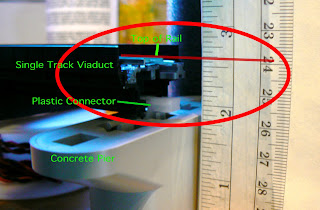
One of the biggest challenges I had to face was thinking that the 2" piers and so forth for the elevated track sections, are actually considerably higher once you add in the plastic supports. Beware if you are building your adjoining sections of the layout to viaducts and other elevated sections using the piers that your actual adjoining elevation will have to be higher. If you use the Piers (which are two inches in height) and the plastic attachments, the top of your rail to your base is between 2 9/16 and 2 5/8 in elevation. I can't fault Kato as they are not wrong, but it would have been helpful if their dimensions measured the top of rail to base distance!


Single Track Viaduct clearance problems.
The inside wall of the single track viaducts are too high to allow your longer passenger cars and rolling stock to go through. The problem is specifically with cars that are longer that 160mm, as I have a set with passenger cars that are 164mm which have problems on both the 282 and 315mm curves, however, my 161mm cars do not appear to touch the inside walls at any point. A very crude (and temporary) solution I had to apply was to sand down the inside walls with my belt sander. Still working on a better plan, possibly with a completely different approach to the elevated track in this area.
Overhead Station Clearance problems. Keep those pantographs down going through the Kato Overhead station! This may be a manufacturer specific only issue, but the pantographs on my Fleischmann electric will not clear the bottom of the Kato station. Since elevating the station is not a good option (the stairways that come with it would not fit right), you either need to install catenary that would push the pantograph down as it goes under the station, keep the pantographs down, or device a system to restrict the full extension of the pantographs on those models where this is an issue. I have noticed this is only a problem on those electric engines that have the capability to draw power from catenary. My Kato Thalys cannot do this, as the pantographs do not go high enough to encounter any obstruction from the station. The actual vertical distance from the bottom of the station to the base is just a hair under 2". However, once you add Kato Unitrack, the vertical clearance between the top of the rails and the bottom of the station is about 1 5/8.


All things considered, the issues I ran into are relatively minor compared to some of the problems I've had with 'traditional' track. I also have to say that I tried to use both Atlas and Minitrix switches on the layout originally, but due to persistent derailments or frog conductivity issues, they were all replaced (except for a couple of Minitrix switches in my mill yard).

Its a great system! It will be interesting to see what Atlas does with its new competitive version of this system. If the two systems are compatible, this could be good news for us N Scale modelers!

For more in depth help, tips, and deeper commentary on the Unitrack system, I recommend the Yahoo Unitrack group and Karayan's Unitrack page, which both contain multiple links to various resources as well. I also go into some more detail on some successful features of this system in this post, which I think articulates some of the unique advantages and capabilities of this system.

UPDATED:  I take a look at Kato's new "super-elevated" curve tracks at this post.

Thursday, January 8, 2009

Locomotive Roster: DB V100; Fleischmann 8-7230

And now time to look at one of the Fleischmann models on the layout. I actually was thinking of posting some more layout pictures since I haven't really focused specifically on that since I laid the track down and completed most of the wiring connections, but I think that sharing my photos of these locomotives on the current layout - while also giving a 'user's opinion' of them-is a decent way to 'kill two birds with one stone'.


On to this post's model....this is a model of a DB V100 with a pre-installed digital decoder, giving it the '8' prefix in Fleischmann's catalog. The detailing on this, like many of the newer models from Minitrix and Fleischmann (don't know about Roco, but I assume this is true) feature a higher level of detail than past versions of these locomotives. I would go so far as to say if you did not know the scale in the photos, you could assume they were HO (except for those classic Rapido stype couplers! Which I don't mind saying that I love for their simplicity and functionality, but I know many people despise them). In fact, before I acquired this locomotive, I had a low impression of Fleischmann quality, which was probably influenced by seeing a lot of Fleischmann HO stuff in the states in the 70's that was never really taken care of (e.g. it was usually in boxes of 'junk' at swap meets). I was very young at the time, but that association sort of stayed in the back of my mind. I am glad to see that it was not true....or at least, is not true today. The locomotive has proven very durable and has even survived a fall from the layout to the floor (which has a thin carpeting material over the concrete....not much protection for the dreaded dropped loco!!!).


Impressions:
Pros:
- Its digital operation from the decoder was flawless from the start. Right out of the box, never had a problem with the programming or operation with either a LokBoss or the Trix Mobile Station.
- Detailing. As mentioned above, it looks great, the headlights have the appropriate amount of brightness.
- Motor: Not the strongest locomotive by any means, but a solid motor, although I find it does work better after having 'warmed up' a bit.
- Insensistive: This locomotive seamingly retains solid electrical contact through virtually all conditions. One of the more reliable operators on the layout.

Cons:
- None to speak of. I've owned it for about 6 months, and no issues. Let's hope that continues!